


Luxury brand marketing in the UAE and Saudi Arabia isn’t about expensive ads; it’s about strategic positioning that justifies premium pricing and builds lasting brand equity.
The opportunity is massive: the GCC luxury market reached $52 billion in 2024, growing 8-12% annually (Bain Luxury Study). The UAE has 68,000+ millionaires. Saudi Arabia has 140,000+ HNWIs, with spending accelerating through Vision 2030.
PGX Agency is a luxury brand marketing agency combining regional expertise with strategic precision. Since 2021, we’ve helped high-end fashion, hospitality, real estate, and lifestyle brands build powerful market positions in Egypt and the GCC.
This guide covers:
- What actually defines luxury in 2025 (beyond price and quality)
- The unique psychology driving luxury purchases in GCC markets
- Strategic frameworks for positioning, pricing, and distribution
- How to maintain exclusivity while scaling digitally
- Luxury marketing metrics that matter (not vanity numbers)
- Common mistakes that damage brand equity permanently
What Defines a Luxury Brand in 2025
Luxury brands don’t compete on price, features, or convenience. They compete on meaning, emotion, and identity.
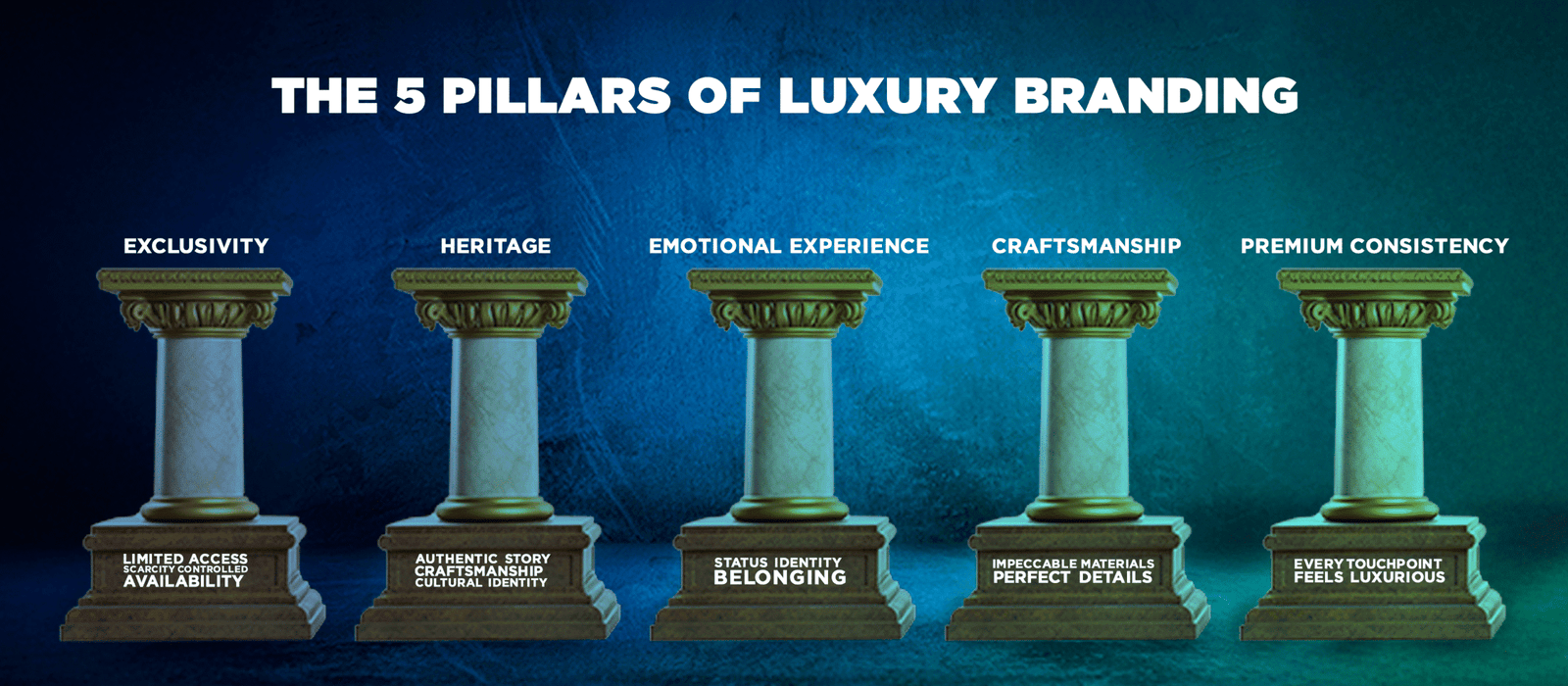
The Five Pillars of Luxury
1. Exclusivity Through Scarcity
Not everyone can have it, by design, not accident.
How scarcity works:
- Production limits: Hermès makes ~200K Birkin bags annually worldwide (12-year waitlist)
- Distribution control: Rolex limits supply to authorized dealers, creating a “shortage.”
- Access restrictions: Soho House requires an application and a member referral
- Time constraints: Seasonal collections disappear permanently, never restocked
Why it works: Humans value what’s hard to obtain. Scarcity triggers the Veblen effect (demand increases as price rises) and the snob effect (value decreases if too common).
GCC application: Exclusivity resonates powerfully in Gulf markets, where luxury signals elite status. Saudi consumers particularly value products that demonstrate privileged access.
2. Heritage and Authenticity
Legacy justifies premium pricing. A story creates an emotional connection.
Types of heritage:
- Historical: Founded 100+ years ago (Cartier 1847, Louis Vuitton 1854)
- Craft tradition: Artisan techniques passed through generations
- Cultural: Connected to a specific place or movement
- Founder vision: Visionary individuals’ philosophy (Coco Chanel, Enzo Ferrari)
For new brands: Can’t fake heritage, but can build an authentic story around:
- Craftsmanship and quality obsession
- Founder’s expertise and vision
- Innovation and category disruption
- Cultural contribution
GCC consideration: Regional luxury consumers deeply respect heritage and tradition. Brands connecting to Arabic craftsmanship heritage or Islamic art traditions resonate strongly.
3. Emotional Experience Over Functional Benefit
Luxury products sell feelings, not features.
What luxury actually provides:
- Status signaling: “I belong to an elite group.”
- Self-expression: “This reflects who I am.”
- Achievement reward: “I deserve this.”
- Hedonic pleasure: “This makes me feel good.”
- Social connection: “This connects me to an aspirational community.”
Example: Rolex doesn’t sell “accurate timekeeping” (your phone does that). They sell “achievement symbols” and “the legacy you pass to the next generation.”
Marketing implication: Stop listing features. Create experiences that trigger desired emotions.
4. Impeccable Design and Craftsmanship
Every detail must be perfect. Quality must be visible, tangible, and undeniable.
Design standards:
- Materials: Premium leather, precious metals, rare fabrics
- Construction: Hand-stitching, precision engineering, quality control
- Aesthetics: Timeless design that won’t date quickly
- Functionality: Works flawlessly (luxury can’t be unreliable)
Why it matters: High-net-worth individuals can afford anything. They choose brands where quality is unquestionable and attention to detail is obsessive.
GCC expectation: Gulf luxury consumers have among the highest quality expectations globally. Subpar quality gets rejected immediately, regardless of brand name.
5. Consistent Premium Experience
Every touchpoint reinforces luxury positioning, from Instagram posts to the retail environment to customer service to packaging.
Touchpoint checklist:
- Website loads instantly and navigates intuitively
- Social content has premium production values
- Retail spaces are designed environments (not just stores)
- Packaging creates unboxing theater
- Customer service is a white-glove standard
- Product quality exceeds expectations
The test: If any touchpoint feels “budget,” the entire brand perception suffers.
Luxury vs. Premium vs. Masstige
Understanding where you sit determines strategy.
| Category | Price Point | Positioning | Example |
| Mass Market | Low | Functional benefit | Zara, H&M |
| Masstige | Mid | Accessible aspiration | Coach, Michael Kors |
| Premium | Mid-High | Superior quality | Hugo Boss, Longchamp |
| Luxury | High | Exclusivity and heritage | Chanel, Cartier |
| Ultra-Luxury | Very High | Ultimate exclusivity | Hermès, Patek Philippe |
Strategy varies dramatically: Masstige needs broad awareness. Ultra-luxury needs controlled exposure. Know your category.
If you want to communicate your brand story through powerful visuals, our [marketing video production] deliver high-quality corporate videos aligned with your brand strategy.

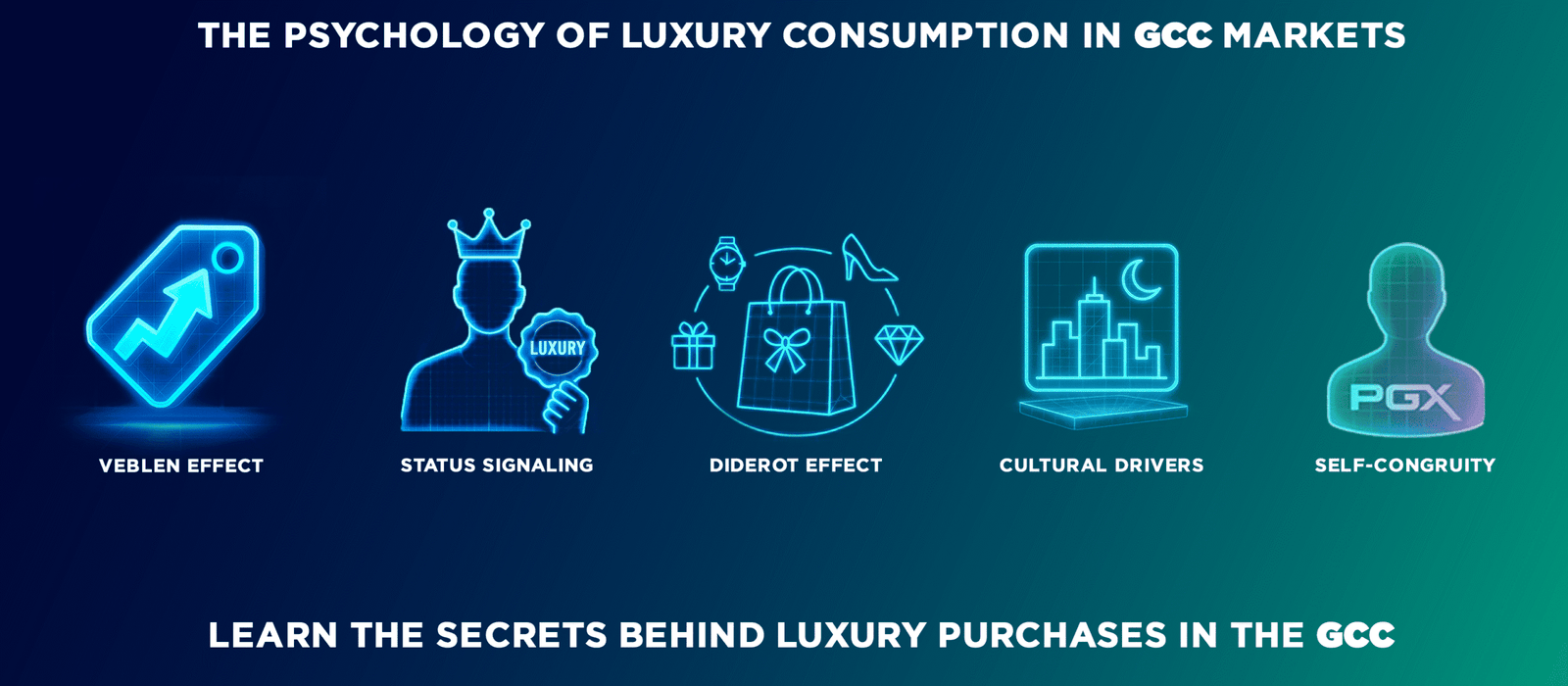
The Psychology of Luxury Consumption in GCC Markets
Understanding buyer psychology is fundamental to luxury brand marketing. Here’s what actually drives purchase decisions.
1. The Veblen Effect: Price Increases Demand
Standard economics: Price ↑ → Demand ↓
Luxury economics: Price ↑ → Demand ↑ (up to a point)
Why: A Higher price signals a higher status. Consumers want products that demonstrate the ability to pay a premium.
Economist Thorstein Veblen (1899) coined the term “conspicuous consumption,” purchasing to display wealth publicly.
GCC application: The Veblen effect is particularly strong in Gulf markets, where luxury purchases signal financial success and social status. Visible brand logos and recognizable luxury items carry social currency.
Marketing implication: Don’t apologize for high prices. Premium pricing IS the strategy (discounts destroy luxury perception permanently).
2. Status Signaling Theory
Luxury purchases communicate identity and social position.
What luxury signals:
- Financial capability (“I can afford this”)
- Taste and sophistication (“I have refined judgment”)
- Achievement (“I’ve earned this”)
- Group membership (“I belong with other luxury consumers”)
Regional nuances:
UAE: Luxury signals cosmopolitan sophistication and global success.
Saudi Arabia: Luxury signals refined taste within a cultural context (modest luxury is growing).
Egypt: Luxury signals aspiration and upward mobility
Marketing implication: Position your product as an identity marker, not just a possession. “This is for people like you” resonates more than “This is well-made.”
3. Self-Congruity Theory
People buy products matching their self-concept (actual or aspirational).
Two types:
- Actual self: “This reflects who I am now.”
- Ideal self: “This reflects who I aspire to become.”
Example: A Young professional buys a Rolex not because they need a watch, but because “successful people wear a Rolex,” and they see themselves as (or aspire to be) successful.
Marketing implication: Show the aspirational lifestyle your product enables. Ferrari doesn’t sell cars; they sell membership in elite automotive culture.
4. The Diderot Effect
Purchasing one luxury item creates pressure to upgrade other possessions to match.
Named after philosopher Denis Diderot, who bought an expensive dressing gown and then felt his other possessions looked shabby by comparison, triggering a cascade of luxury purchases.
Marketing opportunity: Luxury fashion brands leverage this by offering a complete lifestyle (clothing + accessories + fragrances + home goods). Once a customer buys one premium item, they’re more likely to buy others.
GCC application: Family-oriented culture amplifies the Diderot effect. One family member’s luxury purchase influences others’ consumption patterns.
5. GCC-Specific Psychological Drivers
Family approval matters:
- Purchase decisions are often influenced by family members
- Gift-giving culture (luxury items as status gifts)
- Intergenerational wealth (parents introducing children to luxury brands)
Social proof reliance:
- Community recommendations carry more weight than advertising
- Seeing peers with luxury products triggers desire
- Instagram and social media amplify social proof effects
Service expectations:
- Personal relationships valued over transactional efficiency
- Hospitality culture means service quality expectations are higher than in Western markets
- Face-to-face interaction preferred for high-value purchases
Religious sensitivity:
- Modest luxury growing (elegant without ostentatious display)
- Alcohol associations damage brand (avoid nightlife imagery if targeting conservative segments)
- Halal considerations for beauty and food luxury brands
To strengthen your brand presence across social platforms, we also provide [social media marketing services], helping brands build consistent communication and engagement.
The Unique Challenges of Marketing Luxury Brands
Luxury marketing operates under different rules than mass marketing. Understanding constraints is critical.
Challenge 1: The Digital Exclusivity Paradox
The problem: Digital democratizes access (anyone can follow Instagram or browse a website). Luxury requires exclusivity (not everyone should access the brand).
The tension:
- Must be digital: GCC smartphone penetration 90%+, consumers expect online presence
- Can’t be too accessible: Overexposure kills mystique and desire
Solutions:
Controlled digital presence:
- Post frequency: 2-3 times weekly (less than mass brands)
- Production quality: Every image is perfect (no casual behind-the-scenes unless strategic)
- Content curation: Only show what reinforces luxury positioning
Tiered access:
- Public: Brand awareness content (accessible to all)
- Registered: Product details (email required, database building)
- VIP: Exclusive content, early access, private events (invitation only)
Platform selection:
- Instagram: Primary visual storytelling platform
- YouTube: Brand films and craftsmanship stories
- LinkedIn: B2B luxury (high-end services)
- Avoid: TikTok (too casual for most luxury), mass forums
GCC context: High social media usage means digital presence is essential, but Gulf consumers also expect premium in-person experiences. An omnichannel strategy balances both.
Challenge 2: Maintaining Exclusivity While Scaling
The growth dilemma: Want more revenue (requires more customers), but exclusivity requires limited access.
Why growth threatens luxury:
- More customers = less exclusive feeling
- Wider distribution = less controlled brand experience
- Higher awareness = reduced mystique
Solutions:
Vertical expansion (not horizontal):
- Add higher-priced tiers (ultra-premium lines)
- Introduce related categories (fashion brand adds accessories, fragrances)
- Geographic expansion (new markets, not mass distribution in existing markets)
Controlled distribution:
- Selective retail partnerships (premium locations only)
- Never mass market channels (no discount retailers, no marketplaces)
Product hierarchy:
- Entry luxury: Accessible price point (builds awareness, $500-$2,000)
- Core luxury: Main revenue driver ($2,000-$10,000)
- Ultra luxury: Halo effect (limited production, $10,000+)
Example: The Mercedes C-Class ($45K) introduces the brand, the E-Class ($65K) drives volume, and the S-Class ($120K+) reinforces luxury credentials.
Challenge 3: Pricing Without Discounting
The temptation: Sales declining? Offer a discount to move inventory.
Why does this destroy luxury brands?
- Trains customers to wait for sales
- Devalues brand in the minds of full-price customers
- Signals desperation (luxury should never look desperate)
- Difficult to return to premium pricing after discounting
What to do instead:
For excess inventory:
- Private sales (VIP invitation-only, not public)
- Alternative channels (outlet stores in different locations, clearly separated from the main retail)
- Donation (write-off for charity, maintains pricing integrity)
For slow periods:
- Focus on experience, not price (add value through service, not discounts)
- Exclusive access (early release for loyal customers)
- Limited editions (create scarcity, driving urgency)
Never:
- Public promotions or sales
- Discount codes splashed on social media
- Participation in sitewide discount events (Black Friday, 11.11)
GCC consideration: Gulf consumers appreciate value but respect pricing integrity. Consistent premium pricing builds trust more than promotional games.
Challenge 4: Measuring Success Differently
Mass-market metrics don’t work for luxury:
| Mass Market Measures | Luxury Measures |
| Reach and impressions | Brand consideration |
| Website traffic | Qualified engagement |
| Conversion rate | Customer lifetime value |
| Cost per acquisition | Average order value |
| Social followers | VIP customer retention |
Why different: Luxury isn’t about volume. It’s about value per customer and brand equity strength.
Luxury marketing KPIs:
- Brand health: Unaided awareness, Net Promoter Score, brand sentiment
- Customer value: Average Order Value, Lifetime Value, purchase frequency
- Exclusivity indicators: Sell-through rate, waitlist length, return rate
- Engagement quality: Time on site, consultation requests, event attendance
Timeline expectations: Mass marketing can show ROI in weeks. Luxury brand building takes 12-24 months minimum for sustainable results.
Read More : Top Brands with the Best Marketing Strategies in 2025
Strategic Framework: Luxury Brand Marketing in GCC
1. Luxury Brand Positioning
The Positioning Matrix:
Plot your brand on two dimensions:
Dimension 1: Heritage ↔ Innovation
Dimension 2: Accessible ↔ Ultra-Exclusive
Where brands sit:
- Heritage + Ultra-Exclusive: Hermès, Patek Philippe (tradition, impossible to access)
- Heritage + Accessible: Coach, Tiffany & Co. (legacy, but entry points exist)
- Innovation + Ultra-Exclusive: Tesla (when positioned as luxury), Richard Mille (avant-garde scarcity)
- Innovation + Accessible: Michael Kors, contemporary fashion brands
GCC sweet spot: “Contemporary luxury rooted in heritage”
- Respect for tradition and legacy (heritage value)
- Appreciation for innovation and progress (Vision 2030 mindset)
- Balance both for maximum regional appeal
Positioning process:
Step 1: Audit current perception
- Survey target customers: “When you think of [brand], what comes to mind?”
- Social listening: What are people actually saying?
- Competitor comparison: How are you perceived vs. alternatives?
Step 2: Identify positioning gap
- Where do competitors cluster? (Opportunities exist where no one plays.)
- What does the target audience value? (match positioning to priorities)
- What can you authentically claim? (positioning must be defensible.)
Step 3: Define position
- Format: “For [audience] who [need], [brand] is the [category] that [benefit] because [proof].”
Step 4: Validate position
- Test with 20-30 target customers
- Does it resonate emotionally?
- Is it believable?
- Does it differentiate clearly?
Step 5: Activate consistently
- Every touchpoint reinforces the position
- Visual identity reflects positioning
- Messaging derives from positioning
- Service delivery embodies positioning
2. Luxury Pricing Strategy
Prestige pricing psychology: A Higher price signals higher quality when customers can’t easily evaluate quality before purchase.
Pricing strategies:
Ultra-premium positioning (10-50x category average):
- Signals ultimate exclusivity
- Creates scarcity through a price barrier
- Example: Hermès Birkin $10K-$300 vs. the luxury handbag average $2K
Premium positioning (2-5x category average):
- Signals superior quality
- Maintains accessibility for the affluent segment
- Example: Four Seasons hotels $800-$2,000/night vs. upscale average $300-$500
Tiered approach:
- Entry luxury (brand introduction, $500-$2,000)
- Core luxury (volume driver, $2,000-$10,000)
- Ultra luxury (halo effect, $10,000+)
Pricing rules for luxury:
- Never discount core products (destroys brand equity)
- Price anchoring works (show the highest-priced item first; others seem reasonable)
- Transparent pricing builds trust (hidden costs damage luxury reputation)
- Regional pricing consistency (UAE and Saudi prices should be similar)
GCC pricing dynamics:
- Price sensitivity is lower than in many Western markets (wealth concentration)
- But quality must justify price (value-consciousness exists even at the high end)
- Transparent pricing preferred (surprises damage trust)
3. Selective Distribution
Luxury distribution principle: Control where your brand appears. Wrong channel dilutes the brand permanently.
Channel hierarchy:
Tier 1: Own channels (maximum control)
- Brand flagship stores
- Brand website/e-commerce
- Brand mobile app
Tier 2: Premium multi-brand (curated partners)
Tier 3: Never
- Mass department stores
- Discount retailers
- Online marketplaces (Amazon, Noon for luxury dilutes brand)
4. Content Strategy for Luxury
Less is more: Quality over quantity in all forms.
Content pillars:
- Heritage storytelling (30% of content)
- Brand founding story
- Craftsmanship process
- Artisan profiles
- Historical moments
- Product excellence (25% of content)
- Materials and construction
- Design philosophy
- Quality details
- Limited editions
- Lifestyle aspiration (25% of content)
- Customer stories (with permission)
- Brand experiences and events
- Cultural connections (art, architecture, travel)
- Aspirational imagery
- Thought leadership (20% of content)
- Industry insights
- Trend forecasting
- Expert perspectives
- Cultural commentary
Production standards:
- Photography: Professional only, styled shoots, perfect lighting
- Videography: Cinematic quality, storytelling, not selling
- Copywriting: Elevated language, emotion-driven, minimal copy
- Design: Clean layouts, generous white space, premium typography
Posting frequency:
- Instagram: 2-3 posts/week (Stories can be more frequent)
- YouTube: 1-2 videos/month (high production value)
- Blog/Editorial: 1-2 articles/month (substantial, 1,500+ words)
Why less is more: Scarcity applies to content, too. Luxury should be rare in all forms. Overposting makes the brand feel desperate for attention.
5. Luxury Customer Experience
Every touchpoint must feel premium:
Digital experience:
- Website: Loads <2 seconds, intuitive navigation, visual focus
- E-commerce: Concierge checkout option (phone/video support available)
- Personalization: Product recommendations based on browsing/purchase history
- Packaging: Unboxing theater (premium materials, thoughtful presentation)
Physical experience:
- Store design: Environment reflecting brand values (Hermès feels different than Gucci, intentionally)
- Service: Personal shoppers, private appointments, refreshments
- Try-on: Comfortable, unhurried, pressure-free
- Purchase: Payment discreet (no visible cash registers), elegant packaging
Service standards:
- Response time: <2 hours for customer inquiries (faster for VIP)
- Problem resolution: Immediate empowerment (staff can solve issues without multiple approvals)
- Post-purchase: Follow-up within 48 hours, satisfaction check
- Ongoing: Relationship building (birthday notes, exclusive invitations, personalized service)
VIP program structure:
- Tier 1: First purchase (welcome gift, brand introduction)
- Tier 2: Repeat customer (early access to new collections)
- Tier 3: High-value (private shopping, customization options)
- Tier 4: Ultra-VIP (dedicated relationship manager, exclusive events, bespoke services)
How to Build Exclusivity and Desire
Exclusivity separates luxury from premium. Creating desire requires deliberate strategy.
1. Scarcity Engineering
Types of scarcity:
Production scarcity:
- Limited quantities (hand-made constraints, artisan capacity)
- Seasonal collections (gone when the season ends, never return)
- Numbered editions (creates collectibility, 1 of 100)
Access scarcity:
- Invitation-only launches (VIP previews before public)
Time scarcity:
- Pre-order windows (limited time to secure allocation)
- Seasonal availability (only available at certain times of year)
Implementation rule: Don’t fake scarcity; it destroys trust. Use genuine constraints (production capacity, material availability, artisan time).
Example: Hermès genuinely can’t make more Birkin bags without compromising quality (each bag takes 18-24 hours of artisan work). This authentic scarcity creates 12-year waitlists.
GCC application: Scarcity creates urgency in markets where luxury signals status. Limited editions and exclusive access resonate strongly.
2. VIP Experience Design
Reward top customers to strengthen loyalty:
Access benefits:
- Early product releases (see/buy before public launch)
- Exclusive collections (products only available to VIPs)
- Private events (intimate gatherings with brand leadership)
- Customization options (bespoke services, personalization)
Recognition benefits:
- Personalized communications (handwritten notes, birthday gifts)
- Brand insider access (behind-the-scenes content, craftsman meetings)
- Community connection (network with other VIPs)
Why it works: VIP treatment creates emotional bonds transcending transactions. Customers stay loyal because leaving means losing relationships and privileges.
GCC context: Relationship-driven culture amplifies VIP program effectiveness. Personal connections and recognition matter deeply in Gulf markets.
3. Strategic Brand Partnerships
Collaborate with entities sharing brand values:
Types of partnerships:
Cultural partnerships:
- Museums, art galleries, cultural institutions
- Example: Cartier sponsoring major art exhibitions
- Benefit: Associate brand with culture and sophistication
Celebrity/influencer:
- Brand ambassadors embodying brand values
- Example: Roger Federer × Rolex (elegance and excellence)
- Benefit: Reach aspirational audiences through admired figures
Charitable:
- Causes aligned with brand mission
- Example: Tiffany & Co. supporting wildlife conservation (diamonds → nature)
- Benefit: Demonstrates values beyond profit
Partnership criteria:
- Value alignment (do they share your principles?)
- Audience overlap (do they reach your customers?)
- Quality parity (Is their standard equal to yours?)
- Mutual benefit (does each gain something valuable?)
Read More: Brand Development: How PGX Agency Build Strong Brands
Common Luxury Marketing Mistakes
Expertise means recognizing pitfalls. Here’s what damages luxury brands permanently.
Mistake 1: Aggressive Discounting
Why it’s tempting: Drive short-term sales, move excess inventory.
Why does it destroy luxury?
- Trains customers to wait for sales (never pay full price)
- Devalues the brand in the minds of customers who paid full price
- Signals weakness (luxury brands don’t look desperate)
- Nearly impossible to return to premium pricing after discounting
What to do instead:
- Private sales (VIP invitation only, not public promotions)
- Alternative channels (outlet stores physically separated, clearly distinct)
- Inventory management (produce less, create scarcity instead of overproduction)
Data: Luxury brands that discount see a 20-40% brand equity decline that takes years to rebuild (Bain).
Mistake 2: Mass Distribution
Why it’s tempting: Maximize reach, grow revenue quickly.
Why it fails:
- Dilutes exclusivity (if everyone can buy everywhere, it’s not exclusive)
- Loses control (can’t ensure premium retail experience at all locations)
What to do instead:
- Selective distribution (curated premium partners only)
- Direct channels priority (own stores, own e-commerce)
- Quality over quantity (fewer, better locations)
Example: Hermès has ~300 stores globally vs. Zara’s 2,000+. Scarcity of access creates desire.
Mistake 3: Social Media Overposting
Why it’s tempting: “Stay top of mind” with constant content.
Why does it backfire?
- Luxury should be scarce in ALL forms (including content)
- Overposting makes the brand feel desperate for attention
- Reduces perceived value (what’s always available isn’t special)
What to do instead:
- 2-3 posts per week maximum (Instagram feed)
- Higher production value per post (quality over quantity)
- Stories can be more frequent (behind-the-scenes, still premium)
Guiding principle: Would you rather see a luxury brand post 3x daily (feeling like they’re chasing you) or 2x weekly (feeling like each post is a special event)?
Mistake 4: Neglecting Customer Service
Why it’s tempting: Focus marketing budget on acquisition, not retention.
Why it’s fatal for luxury:
- Luxury customers expect perfection always
- One bad service experience destroys a relationship
- Word-of-mouth spreads faster for luxury (tight communities)
What to do instead:
- Invest heavily in service training
- Empower staff to solve problems immediately
- Personal relationship building (dedicated account managers for VIPs)
- Proactive communication (don’t wait for customers to come to you)
Data: 67% of luxury customer churn is due to service issues, not product dissatisfaction (Bain).
Mistake 5: Generic Global Campaigns
Why it’s tempting: Efficiency, one campaign for all markets.
Why it fails in GCC:
- Cultural nuances matter deeply
- Translation ≠ localization
- What works in Paris may offend in Riyadh
What to do instead:
- Global brand identity (consistent)
- Regional campaign execution (culturally adapted)
- Local cultural consultants (prevent mistakes)
Mistake 6: Measuring Wrong Metrics
Vanity metrics don’t matter for luxury:
- Instagram followers (reach ≠ brand equity)
- Website traffic (visitors, ≠ qualified customers)
- Impressions (awareness ≠ , desire)
Luxury metrics that matter:
- Customer Lifetime Value (how much do they spend over time?)
- Average Order Value (are they buying premium items?)
- Net Promoter Score (would they recommend?)
- Brand consideration (do they include you in purchase decisions?)
- VIP retention (are top customers staying loyal?)
The shift: From volume metrics to value metrics.
Mistake 7: Fake Heritage
Why it’s tempting: Heritage sells, so create a “story” even if the brand is new.
Why did it backfire catastrophically?
- Customers detect inauthenticity immediately.
- Destroyed trust is impossible to rebuild
- Legal issues if claims are false
What to do instead:
- If you have heritage: Tell it authentically, with proof (photos, documents, testimonials)
- If you’re new: Focus on craftsmanship, founder vision, innovation, and authentic stories you CAN tell
Example: A New brand claiming “100 years of Italian craftsmanship” when founded in 2020 = disaster. Same brand saying “Trained by 5th-generation Italian artisans bringing centuries-old techniques to modern luxury” = authentic.
Luxury Marketing Metrics & ROI
CFOs and boards demand proof. Here’s how to measure luxury marketing success.
The Three-Tier Measurement Framework
Tier 1: Business Outcomes (what actually matters)
| Metric | Definition | Luxury Target | Why It Matters |
| Revenue Growth | YoY increase | 15-30% | Are we growing? |
| Customer LTV | Total customer spend over the relationship | $10K-$100K+ | Value per customer |
| Average Order Value | Average transaction size | $2K-$20K+ | Purchase quality |
| Gross Margin | Profit per sale | 60-80% | Sustainability |
| Customer Retention | % returning customers | 70-85% | Loyalty strength |
Tier 2: Brand Health (predicting future performance)
| Metric | Definition | Luxury Target | Why It Matters |
| Brand Awareness | % who recognize brand unprompted | 40-60% in the target segment | Consideration prerequisite |
| Brand Consideration | % who’d consider purchasing | 30-50% are aware | Conversion potential |
| Net Promoter Score | Would they recommend it? (-100 to +100) | 50+ | Loyalty indicator |
| Brand Sentiment | Positive vs. negative mentions | 85%+ positive | Reputation health |
| Share of Voice | % of luxury category conversation | 10-20% | Mindshare |
Tier 3: Tactical Performance (optimization opportunities)
| Touchpoint | Metric | Target | Action |
| Website | Bounce rate | <30% | Improve experience |
| Website | Time on site | 3-5 min | Engagement quality |
| E-commerce | Conversion rate | 1-3% | Optimize checkout |
| Open rate | 25-40% | Subject line testing | |
| Social | Engagement rate | 3-8% | Content quality |
| Events | Attendance rate | 40-60% of the invited | Invitation strategy |
The Role of Storytelling in Luxury Branding
Every luxury brand needs a narrative that connects emotionally with its audience. Stories create meaning, justify premium prices, and differentiate you from competitors.
Luxury consumers buy stories, not products.
Types of luxury brand stories:
1. Heritage Narratives
Share your founding story, craftsmanship traditions, or family legacy.
2. Craftsmanship Focus
Showcase the skill, time, and materials that go into each product.
3. Founder Vision
Highlight the philosophy and values that drive the brand.
4. Customer Stories
Feature testimonials from influencers or satisfied clients (with permission).
5. Cultural Connections
Link your brand to art, history, or cultural movements.
6. Storytelling formats:
- Brand films
- Instagram Stories and Reels
- Blog articles
- Event experiences
- Packaging inserts
Every touchpoint should reinforce your narrative.
Why PGX Agency Is the Leading Luxury Brand Marketing Agency in GCC
Choosing the right luxury branding agency determines success or failure. Here’s what differentiates PGX.
1. Luxury-Specific Expertise
We understand luxury psychology:
- Veblen effect, status signaling, self-congruity theory
- UHNW vs. aspirational buyer differences
- GCC cultural luxury drivers
Portfolio:
- Fashion, hospitality, real estate, lifestyle brands
- Ultra-luxury ($10K+ average transaction) to accessible luxury
- Regional and international luxury brands
Approach:
- Strategy before creative (positioning, pricing, distribution decided first)
- Long-term brand building (not just campaign execution)
- ROI measurement (connect marketing to business outcomes)
2. Regional GCC Mastery
Market knowledge:
- UAE: 68,000+ millionaires, cosmopolitan luxury expectations
- Saudi Arabia: 140,000+ HNWIs, Vision 2030 accelerating spending
- Egypt: Emerging luxury segment, aspirational market dynamics
Cultural intelligence:
- Islamic values integration (modest luxury, halal considerations)
- Arabic heritage respect (craftsmanship traditions, cultural connections)
- Family dynamics understanding (purchase influence patterns)
- Service expectations (hospitality culture standards)
Local networks:
- Luxury retail partnerships (mall management, boutique relationships)
- Media connections (fashion publications, lifestyle media)
- Influencer relationships (regional luxury influencers)
- Event venues (premium locations for brand activations)
3. Technology-Powered Personalization
CRM Integration:
- Customer database unifying all touchpoint data
- Purchase history, preferences, interaction tracking
- Segmentation (VIP tiers, purchase behavior, engagement level)
- Personalized communication automation
AI-Powered Insights:
- First GCC agency with integrated AI customer engagement
- Analyzes luxury consumer behavior patterns
- Predicts purchase propensity and lifetime value
- Optimizes messaging and timing per customer
Analytics:
- Real-time dashboards (brand health, campaign performance, ROI)
- Customer journey mapping (touchpoint effectiveness)
- Attribution modeling (which channels drive luxury purchases)
- Competitive benchmarking
Why it matters: Luxury customers expect personalization. Technology enables white-glove service at scale.
Case Studies: How PGX Transformed Luxury Brands in the UAE & KSA
Our process starts with deep market analysis and ends with ongoing optimization. We don’t just launch campaigns; we build long-term brand equity.
Approach:
1. Market Analysis
We study your competitors, target audience, and market positioning.
2. Strategy Development
We define brand positioning, messaging, and channel strategy.
3. Creative Execution
Our team produces campaigns across digital, social, and experiential channels.
4. Performance Optimization
We track results, analyze data, and refine strategies for continuous improvement.
Results:
PGX clients have achieved:
- Increased brand awareness in GCC markets
- Higher engagement with target audiences
- Improved conversion rates
- Stronger brand equity and customer loyalty
Our portfolio spans luxury fashion, hospitality, real estate, and lifestyle brands.
These are the most common questions we receive from luxury brands considering partnership with PGX. Understanding the specifics of luxury marketing helps you make informed decisions about strategy and agency selection.
Get Started: Transform Your Luxury Brand
If you’re ready to position your luxury brand among the GCC’s elite, PGX Agency combines regional expertise, strategic sophistication, and creative excellence to deliver measurable results.
Our Luxury Marketing Services
Brand Strategy & Positioning: Market research, competitive analysis, positioning frameworks, messaging architecture
Visual Identity & Design: Logo, typography, color systems, photography art direction, brand guidelines
Digital Marketing: Website development, social media management, influencer partnerships, email marketing
Content Production: Brand films, photography, copywriting, graphic design
Experiential Marketing: Event design and execution, retail experience design, pop-up activations
Payment plans are available. Typical engagement: 12-18 months for a sustainable luxury brand
Contact PGX Agency today to transform your luxury brand.
FAQs
What makes luxury brand marketing different from regular marketing?
Luxury marketing prioritizes exclusivity, emotion, and brand equity over volume and features. Key differences: customer lifetime value over acquisition volume, brand consideration over mass awareness, controlled distribution (selective retail only), premium pricing without discounts, and quality-over-quantity content. Luxury consumers buy status, identity, and experience, not just products.
Why do I need a specialized luxury brand marketing agency?
Luxury requires expertise in (1) Positioning (heritage vs. innovation balance), (2) Psychology (Veblen effect, status signaling), (3) Cultural adaptation (GCC Islamic values, Arabic heritage, family dynamics), (4) Experience design (white-glove service standards), and (5) Luxury metrics (LTV, AOV, and brand equity vs. vanity metrics). Generic agencies damage luxury brands through discounting, mass distribution, or overexposure.
How important is cultural adaptation for luxury brands in the UAE and KSA?
Critical. GCC luxury consumers expect Islamic values integration (modest luxury, halal considerations), Arabic heritage respect (craftsmanship traditions), family involvement in purchase decisions, higher service standards (hospitality culture), and community recommendations over advertising. Culturally adapted campaigns outperform generic global campaigns by 40-60% in regional markets.
What digital channels work best for luxury brands?
Best: Instagram (visual storytelling), YouTube (brand films, craftsmanship), luxury e-commerce platforms (Net-a-Porter, Farfetch, not Amazon), brand websites (experiential, not transactional), LinkedIn (B2B luxury), and private VIP communities. Avoid: Mass marketplaces that dilute exclusivity. Strategy: 2-3 curated posts weekly, premium production values always, quality over quantity.
Does PGX Agency work with luxury brands outside the UAE and KSA?
Yes. PGX serves luxury clients across Egypt and the full GCC (UAE, Saudi Arabia, Kuwait, Qatar, Bahrain, Oman). We specialize in cross-market expansion, cultural adaptation while maintaining brand consistency, and helping international luxury brands enter GCC markets successfully.
What’s included in PGX’s luxury brand marketing services?
Complete luxury brand building: Strategy (positioning, pricing, distribution), Visual Identity (logo, typography, brand guidelines), Digital Marketing (website, social media, influencer partnerships), Content Production (brand films, photography), Experiential Marketing (events, retail design), Technology Integration (CRM, personalization, analytics), and Ongoing Optimization (measurement, ROI tracking). An integrated approach ensures consistency across all touchpoints.
How long does it take to see results from luxury brand marketing?
Months 1-6: Brand foundation, awareness growth (limited sales impact)
Months 6-12: Consideration increases, first revenue growth visible
Months 12-24: Loyalty compounds, referrals accelerate, ROI multiplies
Quick wins (30-90 days): Website conversion, email engagement, and service improvements. Sustainable luxury positioning requires 18-24 months; patience builds long-term brand equity.
What are the biggest luxury marketing mistakes to avoid?
Fatal errors: (1) Discounting core products (permanent brand damage), (2) Mass distribution (dilutes exclusivity), (3) Social media overposting (luxury should be scarce), (4) Poor customer service (luxury demands perfection), (5) Generic global campaigns (miss GCC cultural nuances), (6) Wrong metrics (volume vs. value), (7) Fake heritage (consumers detect immediately). Prevention: Strategic discipline, long-term thinking, regional expertise, quality over shortcuts.


