


Brand experience marketing is every interaction between your business and your audience, your website speed, packaging texture, email tone, support response time, store atmosphere, and unboxing moment. When these touchpoints work together strategically, they create preference that transcends price and features.
The data is clear:
- Emotionally connected customers have 306% higher lifetime value (Harvard Business Review)
- 86% of buyers pay more for better experiences (PWC)
- 5% increase in retention creates 25-95% profit increase (Bain & Company)
In Egypt and GCC markets, where consumers compare options instantly and switch brands effortlessly, experience becomes your only defensible competitive advantage.
This guide covers:
- What brand experience marketing actually is (and what it’s not)
- The psychology that makes experiences stick in memory
- Strategic frameworks you can implement immediately
- How to audit and improve your brand experience systematically
- Real examples with quantified results (not just inspiration)
- GCC-specific cultural considerations that matter
What Is Brand Experience Marketing?
Brand experience marketing is the strategic design of every touchpoint to create consistent perceptions, emotions, and memories that drive preference and loyalty.
The Complete Touchpoint Ecosystem
Pre-Purchase (Awareness & Consideration):
- How they discover you (ads, social, search, referral)
- Website first impression (speed, clarity, navigation)
- Content consumption (blog, video, social posts)
- Sales interaction (responsiveness, expertise, pressure)
Purchase (Transaction):
- Checkout process (friction, clarity, trust signals)
- Payment experience (options, security, confirmation)
- Communication (order confirmation, shipping updates)
Post-Purchase (Usage & Retention):
- Delivery experience (packaging, timing, condition)
- Product/service quality (meets or exceeds expectations)
- Onboarding (how easy it is to get started and see value)
- Support interactions (speed, empathy, resolution)
Advocacy (Loyalty & Referral):
- Continued engagement (content, community, updates)
- Recognition (loyalty rewards, VIP treatment)
- Referral ease (how simple it is to recommend you)
- Social proof (reviews, testimonials, user-generated content)
Each touchpoint either strengthens or weakens your brand.
Brand Experience vs. Customer Experience vs. Experiential Marketing
These terms are often confused. Here’s the distinction:
| Concept | Focus | Scope | Example |
| Brand Experience | Total perception across ALL touchpoints | Before, during, after purchase + non-customers | Apple’s minimalist aesthetic everywhere |
| Customer Experience | Service quality during transactions | Purchase and support interactions only | Amazon’s easy returns process |
| Experiential Marketing | Specific campaigns creating memorable moments | Temporary activations and events | Red Bull’s extreme sports events |
Brand experience is the umbrella containing the other two. It’s your strategic approach to shaping perception holistically.
Why Traditional Marketing Isn’t Enough
Traditional marketing: Push messages to audiences (ads, billboards, commercials)
Brand experience marketing: Create moments people want to participate in and remember
The shift:
Traditional assumes: Awareness → Consideration → Purchase
Reality is: Experience → Emotion → Memory → Preference → Purchase → Loyalty → Advocacy
Advertising creates awareness. Experience creates preference. In competitive markets where everyone advertises, experience becomes the differentiator.
To strengthen your brand presence across social platforms, we also provide [social media marketing agency], helping brands build consistent communication and engagement.

The Psychology Behind Brand Experiences
Understanding why experiences work reveals how to design them strategically.
1. Memory Formation Through Emotion
The neuroscience:
Human brains have two memory systems:
- Declarative memory: Facts and information (weak, easily forgotten)
- Emotional memory: Feelings and experiences (strong, permanently stored)
When something triggers emotion, surprise, joy, relief, or frustration, the amygdala signals, “This matters; remember it.” That’s why you remember your wedding day but forget what you had for lunch last Tuesday.
Marketing implication:
Listing features (declarative) gets forgotten. Creating feelings (emotional) gets remembered.
Nike example: “Just Do It” isn’t information; it’s an emotional trigger associated with determination, courage, and achievement. You remember how Nike makes you feel, not their shoe specifications.
2. The Peak-End Rule
Discovery: Nobel Prize-winning psychologist Daniel Kahneman proved people judge experiences by two moments: the peak (most intense) and the end (final moment). Everything else gets averaged out mentally.
Marketing application:
Design your highest-impact moment (peak) and perfect your ending.
Examples:
- Disney parks: Engineer peak moments throughout the day (character interactions, rides), end with a fireworks spectacular
- Apple unboxing: Peak is revealing the product (carefully designed packaging removal), and the end is the “Designed by Apple in California” message
Your business: Identify your peak moment (product delivery? first use? problem resolution?) and your ending (last communication? follow-up? renewal?). Optimize both ruthlessly.
3. Decisions Happen Subconsciously First
The timeline of decision-making:
- 0.2 seconds: Emotional reaction (limbic system activates)
- 2-3 seconds: Conscious awareness (rational brain catches up)
- 5+ seconds: Logical justification (we explain our emotional decision rationally)
By the time someone “decides” to buy, their brain already knows. Brand experience shapes that preconscious reaction.
Example: You walk into two cafes.
Cafe A: Harsh lighting, chaotic layout, indifferent staff, generic music
Cafe B: Warm lighting, organized space, welcoming staff, curated playlist
Within 0.2 seconds, your limbic system decides which feels better. You’ll rationalize later (“Cafe B has better coffee”), but the decision already happened emotionally.
Marketing implication: Every sensory detail matters because emotional reactions happen before rational evaluation.
4. Cognitive Ease Drives Preference
Principle: Humans prefer things that require less mental effort.
Research: When something is easy to think about, perceive, or interact with, we:
- Judge it as more trustworthy
- Perceive it as more valuable
- Choose it more often
- Remember it more favorably
Brand experience applications:
Make interactions effortless:
- Website loads in <2 seconds (slow = difficult = abandoned)
- Checkout in ≤3 steps (complexity = friction = cart abandonment)
- Support answers in <2 hours (delay = frustration = churn)
Make information clear:
- Simple language (jargon = cognitive effort = confusion)
- Visual hierarchy (clear structure = easy scanning)
- Consistent design (familiarity = processing ease)
Apple’s genius: Their minimalist design isn’t just aesthetic; it’s a cognitive ease strategy. Fewer choices, clearer information, and simpler interactions = effortless experience = preference.
5. GCC Cultural Psychology
Brand experience effectiveness varies by culture. What works in New York may fail in Cairo or Riyadh.
Egypt:
- Value-consciousness: Experience must justify the price clearly
- Personal relationships: Face-to-face builds trust faster than digital
- Community orientation: Family and friend recommendations > advertising
- Humor appreciation: Conversational, warm tone resonates
Saudi Arabia:
- Formality gradient: More formal initially, warm up through the relationship
- Gender considerations: Separate family sections, women-only options
- Religious sensitivity: Prayer time accommodations, Ramadan adaptations
- Status signaling: Premium experiences as social currency
UAE:
- Luxury expectations: Premium quality across all touchpoints expected
- Cultural diversity: Multilingual, globally-informed audience
- Innovation appetite: Technology-forward experiences valued
- Service standards: Higher expectations than most markets
To translate your brand identity into strong visuals, our team offers [Best graphic design company] that ensure a cohesive and memorable brand image.
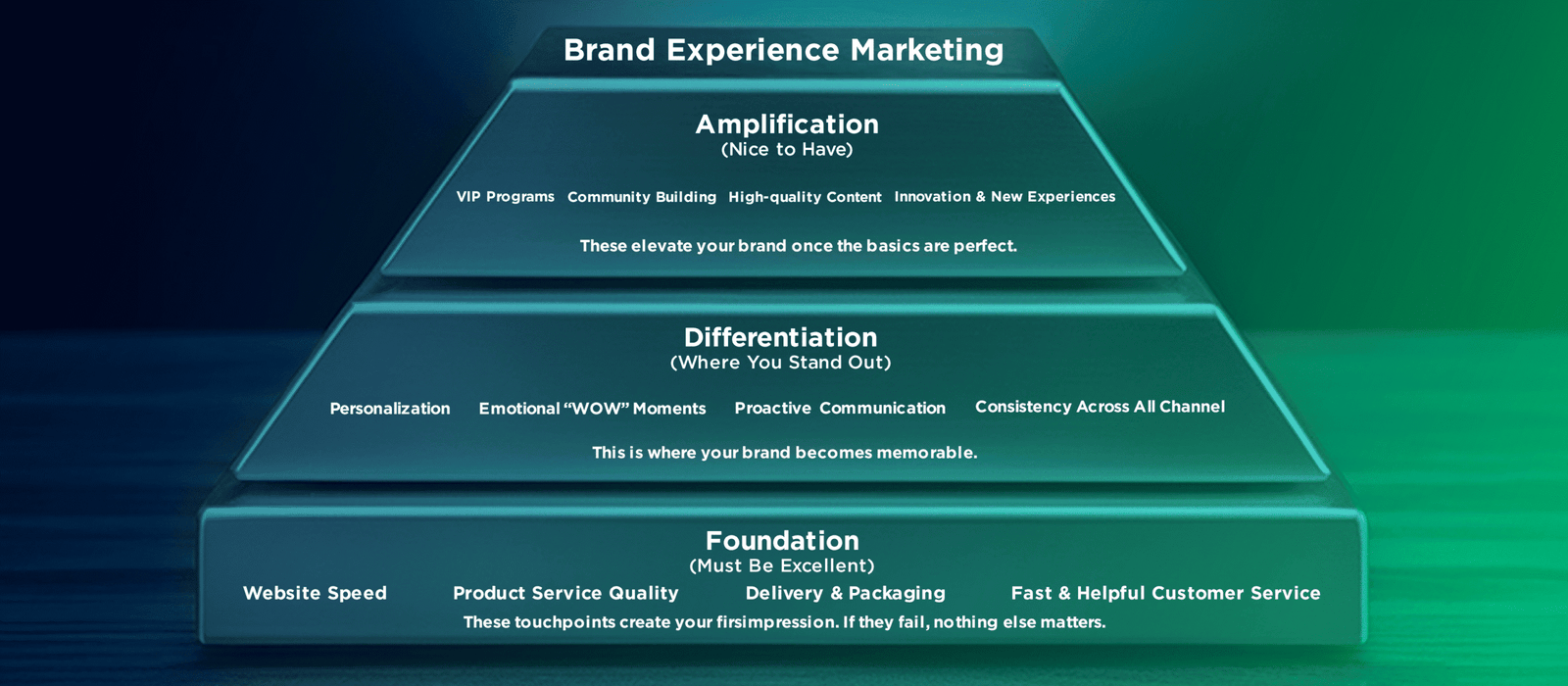
Strategic Framework: The Brand Experience Pyramid
Not all touchpoints matter equally. Prioritize strategically.
Tier 1: Foundation (Must Be Excellent)
These touchpoints form first impressions and handle high-stakes moments. Fix these before optimizing anything else.
Digital foundation:
- Website homepage (first impression in <3 seconds)
- Product/service pages (where purchase decisions form)
- Checkout process (where revenue happens or dies)
- Mobile experience (90%+ GCC users are mobile-first)
Physical foundation:
- First in-person interaction (sets relationship tone)
- Product/service quality (must deliver on promise)
- Packaging/delivery (physical brand moment)
Service foundation:
- Response time (speed signals care)
- Problem resolution (defines trust)
- Consistency (reliability over time)
Investment: 60% of the brand experience budget here. Foundation problems kill everything else.
Tier 2: Differentiation (Where You Stand Out)
Once the foundation is solid, differentiate through memorable moments.
Emotional peaks:
- Surprise elements (unexpected value or delight)
- Personalization (shows you know them specifically)
- Expertise demonstration (proves you’re worth premium)
- Community building (belonging and identity)
Service excellence:
- Proactive communication (anticipate needs before being asked)
- Above-and-beyond moments (exceed expectations notably)
- Consistent quality (never let them down)
Investment: 30% of the budget. This is where loyalty gets built.
Tier 3: Amplification (Nice to Have)
Polish and sophistication that compound advantages.
Brand refinement:
- Advanced personalization (behavioral predictions)
- Content excellence (education and entertainment)
- Community programs (VIP experiences, events)
- Innovation showcasing (stay ahead of the category)
Investment: 10% of the budget. Only after Tiers 1-2 are excellent.
How to Audit Your Brand Experience (Step-by-Step)
Most businesses don’t know which touchpoints are broken. Here’s how to diagnose systematically.
Phase 1: Rate Each Touchpoint
Score every touchpoint from the customer’s perspective (not yours).
Rating scale:
10 = Exceptional (actively creates preference; customers mention it unprompted)
7-9 = Good (meets expectations, no complaints)
4-6 = Adequate (functional but forgettable)
1-3 = Poor (creates friction, customers complain)
How to rate objectively:
- Experience it yourself: Go through your own customer journey anonymously
- Ask 10 customers, “Rate this touchpoint 1-10 and explain why.”
- Check data: Bounce rates, cart abandonment, support tickets, reviews
- Compare competitors: How do you stack up?
Common findings:
- Website: You think it’s clear (8/10). Customers think it’s confusing (4/10).
- Support: You respond in 24 hours (you’re proud). Customers expect <4 hours (they’re frustrated).
- Packaging: You use generic boxes (cost-effective). Competitors use branded packaging (customers remember them).
Brutal honesty required. This audit only works if you face reality.
Phase 2: Prioritize Fixes
Plot touchpoints on a matrix:
Impact vs. Effort Grid:
| Low Effort | High Effort | |
| High Impact | DO FIRST (quick wins) | PLAN & EXECUTE (strategic projects) |
| Low Impact | DO WHEN TIME ALLOWS | DON’T DO (not worth it) |
High Impact, Low Effort (Do First):
- Example: Improve email response time from 24h → 4h (change process, no tech needed)
- Example: Add thank-you note to package (costs $0.20, creates memorable moment)
- Example: Update homepage hero message to be clearer (2 hours of work, huge conversion impact)
High Impact, High Effort (Plan & Execute):
- Example: Rebuild mobile experience (3 months, $15K, but 70% of traffic is mobile)
- Example: Implement CRM for personalization (2 months, $10K, but retention improves 40%)
- Example: Create onboarding program (6 weeks, internal resources, but reduces churn 30%)
Focus: Fix everything in “Do First” within 30 days. Tackle one “Plan & Execute” per quarter.
Phase 3: Implement & Measure (Ongoing)
30-day sprint:
- Week 1: Fix 3 quick-win touchpoints
- Week 2: Fix 3 more
- Week 3: Train team on new standards
- Week 4: Measure improvement
Measurement:
Track before/after metrics:
- Website: Bounce rate, time on site, conversion rate
- Support: Response time, resolution time, satisfaction score
- Retention: Repeat purchase rate, churn rate, LTV
- Advocacy: NPS, referral rate, review volume
Every 90 days: Re-audit, identify next priorities, and repeat.
The compounding effect: Each improvement makes the next easier. First fixes might improve conversion by 5%. After 6 months of continuous improvement, you’re 30-40% better than where you started.
Read More: What is Branding? How to Build a Strong Brand in Egypt, Saudi Arabia & UAE
Common Brand Experience Mistakes (And How to Avoid Them)
Mistake 1: Inconsistency Across Channels
What it looks like:
- Professional website, amateur Instagram
- Formal email tone, casual phone conversations
- Premium product, cheap packaging
Why it happens: Different teams own different channels without central guidelines.
Customer impact: Confusion erodes trust. “Which version is real?”
Fix:
- Create brand experience guidelines (not just visual, tone, service standards, quality expectations)
- Train all teams on guidelines
- Quarterly audits for consistency
- Single owner accountable for brand experience
Mistake 2: Fake Personalization
What doesn’t work:
- “Hi [First Name]” in emails (everyone does this; no one cares)
- Generic birthday discounts (impersonal despite being “personal”)
- Recommendations based on nothing
What actually works:
- Behavior-based recommendations (“You browsed here; X; here’s Y that complements it.”)
- Context-aware messaging (different message to new vs. returning customer)
- Genuine recognition (support rep knows your history and doesn’t make you repeat it)
Fix: Use CRM data to personalize based on actions, not just demographics.
Mistake 3: Neglecting Post-Purchase Experience
The pattern: Obsess over acquisition, ignore retention.
The reality: Acquiring a new customer costs 5-7x more than retaining an existing one.
Where brands fail:
- Confirmation email is bland (missed brand moment)
- Delivery is generic (no unboxing experience)
- No onboarding (customer doesn’t know how to get value)
- Support is reactive (wait for problems instead of preventing them)
Fix: Map the post-purchase journey as carefully as the pre-purchase. Design delivery, onboarding, support, and continued engagement intentionally.
Mistake 4: Measuring Vanity Metrics
What doesn’t matter:
- Instagram likes and follows (unless they convert)
- Website traffic (unless it leads to revenue)
- Email open rates (unless readers take action)
What actually matters:
- Net Promoter Score (would they recommend?)
- Customer Lifetime Value (how much do they spend over time?)
- Retention rate (do they come back?)
- Referral rate (do they recruit others?)
- Revenue per customer (are they buying more?)
Fix: Connect every metric to business outcomes. If a metric doesn’t correlate with revenue or retention, stop tracking it.
Mistake 5: Copying Competitors
The trap: “Competitor X does Y, so we should too.”
The problem: Copying creates parity, not preference. If your experience is the same as competitors, customers choose based on price.
The strategy: Audit competitors to identify gaps (what NO ONE does well), then own that territory.
Example: If all competitors in your category have slow support, become the fast-response brand. If all are formal, be conversational. If all are generic, be personal.
Differentiation requires different experiences, not better versions of the same experience.
Mistake 6: Complexity Overload
More touchpoints ≠ better experience. Sometimes, fewer, better touchpoints win.
Example: Apple Store has ONE primary touchpoint (Genius Bar + sales floor) designed exceptionally. Samsung has 20 touchpoints (more apps, more features, more options), creating complexity and confusion.
Principle: Master critical touchpoints before adding more.
Fix: Audit your touchpoints. Eliminate low-impact ones that consume resources. Focus energy on high-impact moments.
Real Examples: How Elite Brands Engineer Experiences
Careem: Regional Brand Experience Dominance
The context: Uber entered the Middle East first with a global playbook. Careem entered later but understood the regional experience needs.
Strategic experience decisions:
- Cash payments (solved adoption barrier)
- GCC credit card adoption was low (2012-2015)
- Uber required cards; Careem accepted cash
- Removed friction, accelerated growth
- Captain profiles (built trust through transparency)
- Photos, ratings, and vehicle details are visible
- Addressed safety concerns in conservative markets
- Created a community feeling among drivers
- Arabic-first interface (made experience intuitive)
- Uber’s Arabic was translation; Careem’s was native
- Cultural nuances in language mattered
- Reduced cognitive load for Arabic speakers
- Phone support (addressed service expectations)
- Regional customers expect human support
- Chat-only felt impersonal
- Phone support differentiated from Uber
- Cultural timing (adjusted for regional patterns)
- Prayer time notifications
- Ramadan features
- Family ride options (women-only for Saudis)
Quantified results:
- Dominated GCC: 45% market share vs. Uber’s 35% (despite later entry)
- Acquired by Uber for $3.1 billion (2019)
- Higher customer retention than Uber in regional markets
Replicable principle: Understand cultural context deeply. Adapting experience to actual user behavior (not ideal behavior) creates competitive moats.
Noon: E-Commerce Experience Localization
The challenge: Competing with Amazon (infinite resources, global scale) in GCC markets.
Experience differentiation strategy:
- Arabic-first experience (not translation)
- Navigation designed for Arabic reading patterns
- Product descriptions in native Arabic (not translated into English)
- Customer support in regional dialects
- Local payment methods
- Cash on delivery (addressed trust concerns)
- Local bank integrations
- Regional credit options
- Regional brands prioritized
- Highlighted GCC and MENA brands
- Made local products discoverable
- Positioned as supporting the regional economy
- Cultural calendar integration
- Ramadan shopping features
- National Day celebrations
- Regional holiday timing
- Faster regional delivery
- Local warehouses reduced delivery time
- Same-day delivery in major cities
- Reliable timing during peak periods
Results:
- 30% market share in UAE e-commerce (competitive with Amazon)
- $1 billion valuation (2019)
- Higher repeat purchase rate than Amazon in GCC markets
Replicable principle: When competing with larger players, win on experience fit (designed for a specific audience), not feature parity (trying to match everything they do).
Read More: Branding vs Marketing: Which Matters More for Business Growth?
Digital vs. Physical Brand Experiences: When Each Works
Digital Experiences Excel At:
Scale: Reach unlimited customers simultaneously
Data: Track every interaction for optimization
Speed: Update instantly across all channels
Personalization: Automated but relevant
Cost: Lower per-interaction expense
Best digital touchpoints:
- Website: Your 24/7 brand representative must load <2 seconds and convert clearly
- Email: Personalized sequences that educate and nurture
- Social media: Quick responses (< 2 hours), authentic engagement
- Mobile apps: Solve specific problems, create daily habits
GCC context: Smartphone penetration is >90%, making digital-first strategies effective for most businesses.
Physical Experiences Create:
Sensory engagement: Touch, smell, spatial experience
Human connection: Face-to-face builds deeper trust
Memorability: Physical moments form stronger memories
Shareability: Unique experiences become social content
Best physical touchpoints:
- Packaging: Unboxing is brand theater, surprise, and delight
- Retail environments: Space that tells your story tangibly
- Events: Bring brand to life through experiences
- Product quality: Physical proof of brand promise
GCC context: Relationship-driven cultures value face-to-face interaction. Physical touchpoints often close deals that digital started.
The Integration Strategy
Elite brands don’t choose digital OR physical; they orchestrate both seamlessly.
Example customer journey:
- Discover on Instagram (digital) → Visual brand impression
- Visit website (digital) → Learn and evaluate
- Receive personalized email (digital) → Timely offer
- Visit the showroom (physical) → Touch and experience
- Purchase online (digital) → Convenient transaction
- Receive premium packaging (physical) → Unboxing moment
- Get follow-up message (digital) → Relationship continues
- Share experience on social (digital) → Become an advocate
Each step reinforces the others. Consistency across channels creates a cumulative brand impression stronger than any single touchpoint.
Brand Experience Measurement: Track What Matters
The Three-Tier Measurement Framework
Tier 1: Business Outcomes (Monthly)
These metrics actually matter to your business survival and growth.
| Metric | What It Measures | Target | Why It Matters |
| Revenue Growth | Are we growing? | 15-30% YoY | Ultimate success measure |
| Customer Lifetime Value | How much do they spend over time | Increasing | Shows loyalty depth |
| Customer Acquisition Cost | Cost to get a new customer | Decreasing | Shows efficiency |
| Retention Rate | % who come back | 70-85% | Cheaper than acquisition |
| Gross Margin | Profit per sale | 40-60% | Can you sustain growth? |
Tier 2: Brand Health (Quarterly)
These predict future business performance.
| Metric | What It Measures | Target | Why It Matters |
| Net Promoter Score (NPS) | Would they recommend it? | 50+ | Predicts growth |
| Customer Effort Score | How easy was the experience? | <3/7 | Friction = churn |
| Brand Awareness | Do they know you exist? | 60-80% in the target market | Prerequisite for consideration |
| Consideration Rate | Do they consider buying? | 30-50% is aware. | Conversion potential |
| Sentiment | What do they say about you? | 80%+ positive | Reputation health |
Tier 3: Touchpoint Performance (Weekly)
These show where to optimize tactically.
| Touchpoint | Metric | Target | Action |
| Website | Bounce rate | <40% | Improve clarity/speed |
| Website | Conversion rate | 2-5% | Optimize journey |
| Open rate | 20-30% | Test subject lines | |
| Click rate | 3-5% | Improve content | |
| Support | Response time | <2 hours | Add capacity |
| Support | Resolution rate | >90% first contact | Train team |
How to Calculate Brand Experience ROI
Investment:
- Brand experience improvements: $X
- Staff training: $Y
- Technology/tools: $Z
- Total: $X + $Y + $Z
Return (12-month period):
- Increased LTV: (New LTV – Old LTV) × # customers = $A
- Reduced CAC: (Old CAC – New CAC) × # new customers = $B
- Improved retention: Additional revenue from retained customers = $C
- Total Return: $A + $B + $C
ROI: (Total Return ÷ Total Investment) × 100
Typical results: 300-500% ROI within 18-24 months for businesses implementing strategic brand experience improvements.
How PGX Agency Builds Brand Experiences That Drive Growth
Since 2021, we’ve helped businesses across Egypt and the GCC create integrated brand experiences with measurable results.
Our Process
Phase 1: Discovery & Audit
We diagnose the current state before prescribing solutions.
Activities:
- Audit all existing touchpoints (digital, physical, service)
- Experience your customer journey anonymously
- Interview 10-15 customers (understand perception vs. intention)
- Analyze competitor experiences (identify gaps)
- Review your data (bounce rates, conversion, retention, support tickets)
Deliverable: Brand Experience Audit Report with prioritized improvement roadmap
Phase 2: Strategy & Design
We design experience architecture before executing tactics.
Activities:
- Define your brand experience positioning (what feeling you own)
- Map the ideal customer journey across all touchpoints
- Prioritize touchpoints by impact and effort
- Design experience flows (what happens at each stage)
- Create measurement frameworks (leading and lagging indicators)
Deliverable: Brand Experience Strategy with implementation timeline and budget
Phase 3: Execution
We implement improvements systematically, starting with the highest-impact touchpoints.
Our capabilities:
Visual Identity: Logo, colors, typography, photography style, consistent across all touchpoints
Website Development: Fast-loading, mobile-first, conversion-optimized digital hub
Social Media Management: Authentic engagement, quick responses, community building
Content Creation: Photography, video, graphics that embody brand experience
CRM Integration: Connect customer data across touchpoints for personalization
Service Design: Standards, scripts, training for consistent human interactions
Deliverable: Implemented brand experience improvements with before/after metrics
Phase 4: Optimization
We measure, learn, and continuously improve.
Activities:
- Track performance across all touchpoints weekly
- Gather customer feedback systematically
- Run A/B tests on key moments
- Identify new improvement opportunities
- Adjust strategy based on data
Deliverable: Monthly performance reports with optimization recommendations
Our Technology Advantage
CRM Integration: Connect customer data across touchpoints. When someone interacts on Instagram, your sales team knows. When they purchase, your support team has full context.
AI-Powered Personalization: Show relevant content automatically. Email sequences adapt to behavior. Product recommendations improve with each interaction. No manual work required.
Analytics Dashboards: See which touchpoints drive results in real-time. Understand customer paths from first touch to purchase. Calculate ROI for every channel.
Marketing Automation: Deliver consistent experiences without manual effort. Welcome sequences, abandoned cart recovery, and re-engagement campaigns run automatically.
This infrastructure matters because consistency at scale requires systems, not just effort.
Brand experience marketing isn’t about having the biggest budget; it’s about understanding that every touchpoint either strengthens or weakens your brand and designing each one strategically.
The brands that win don’t just sell products. They create feelings customers remember and experiences they want to repeat.
In Egypt and GCC markets, where competition intensifies daily, experience is your only defensible advantage. Features get copied. Pricing gets matched. Advertising gets ignored.
But experiences, when designed authentically and executed consistently, create preference that transcends rational comparison.
The question isn’t whether to invest in brand experience. The question is whether you’ll design it intentionally or let it happen accidentally.
Every day without a strategy is a day competitors improve their experiences while yours stays static.
PGX Marketing Agency, Building brand experiences that turn customers into advocates.
FAQs
What’s the difference between brand experience and customer experience?
Customer experience focuses on service interactions, purchasing, support, and returns. Brand experience includes every touchpoint, even before someone becomes a customer. It’s their total perception of your brand across awareness, consideration, purchase, usage, and advocacy. Customer experience is a subset of brand experience.
Which brand touchpoints matter most?
The ones where customers make decisions or form opinions. Usually: website homepage, product pages, checkout process, first email, delivery experience, and customer support. Fix these before optimizing everything else. Use the audit framework in this article to identify YOUR highest-impact touchpoints specifically.
Can brand experience work for B2B companies?
Absolutely. B2B buyers are still humans making emotional decisions. Your website clarity, sales process smoothness, proposal quality, onboarding thoroughness, and account management all create your brand experience. B2B often has fewer touchpoints but higher stakes per interaction, making experience design even more critical.
How long until brand experience efforts show results?
Quick wins: 30-90 days (improved website conversion, email open rates, response satisfaction)
Building loyalty: 6-12 months (repeat purchases, referrals, NPS improvement)
Competitive advantage: 18-24 months (sustainable differentiation, premium pricing power)
Start with high-impact, low-effort improvements for fast results while planning longer-term strategic enhancements.
What’s the biggest brand experience mistake businesses make?
Inconsistency across channels. Professional website, but amateur social media. Formal emails, but casual phone calls. Premium product but cheap packaging. Customers notice disconnects,, and trust erodes. Fix: Create brand experience guidelines covering tone, quality, and service standards across ALL touchpoints. Train every team member. Audit quarterly.


